President of Uzbekistan and Prime Minister of Japan agree to establish an “expanded strategic partnership for future generations”. Agreements are signed in the fields of education, healthcare, environment, transport, urban planning, tourism, agriculture, and disaster risk reduction.
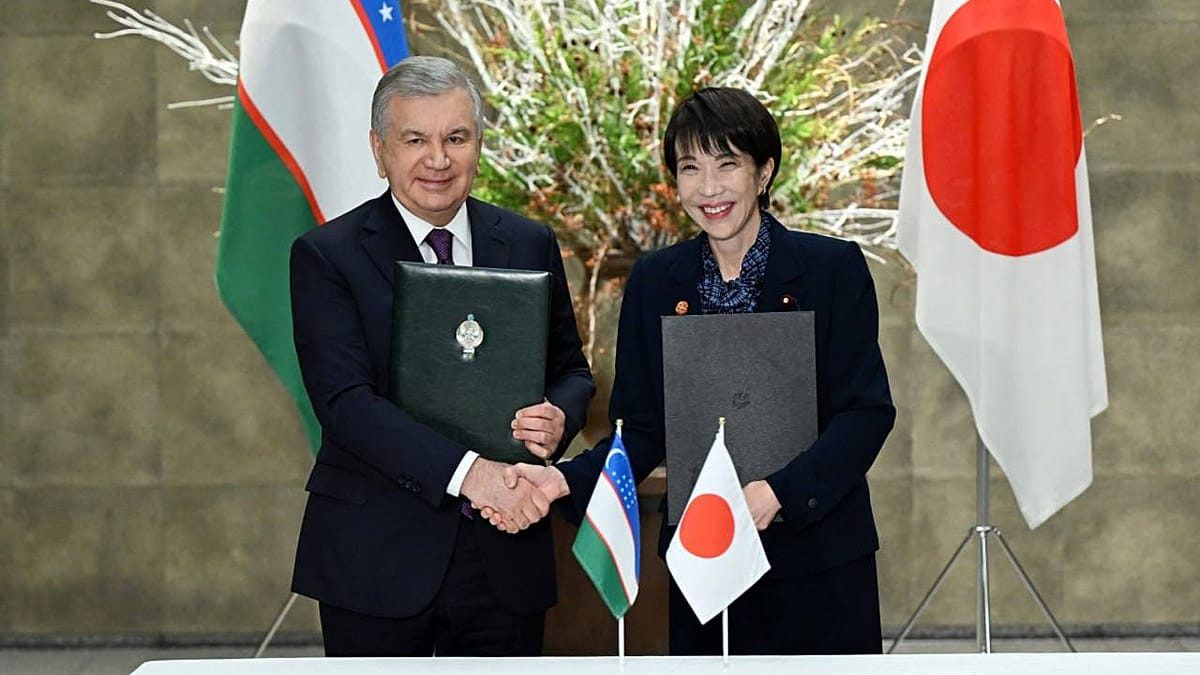
Uzbekistan and Japan agree to establish an “expanded strategic partnership for future generations”. This was stated in a joint statement by the President of Uzbekistan, Shavkat Mirziyoyev, and the Prime Minister of Japan, Sanae Takaichi, following talks in Tokyo on Saturday.
The parties express confidence that the document will raise interaction to a new level and open wide horizons for increasing multifaceted cooperation.
As part of the official visit of the President of Uzbekistan, a package of agreements is also adopted in the fields of education, healthcare, environment, water resources, transport, urban planning, tourism, agriculture, and disaster risk reduction.
What was discussed at the talks Issues of deepening Uzbek-Japanese relations were considered at the talks. Shavkat Mirziyoyev notes that for 33 years since the establishment of diplomatic relations, Japan has always been a close friend and one of the key technological and investment partners of Uzbekistan. It has made a significant contribution to the creation of a modern industrial and energy infrastructure and the development of the republic’s human potential, he says.
The Prime Minister of Japan calls the first visit of Shavkat Mirziyoyev in six years (he visited the country in December 2019) an important event and notes that Uzbek-Japanese ties have traditionally been built on the principles of special trust and mutual respect.
The President of Uzbekistan names green energy and industrial decarbonisation, information technology, critical minerals, cooperation in mechanical engineering, and the modernisation of healthcare and tourism infrastructure as key areas for developing the partnership with Japan.
The head of the Japanese government notes that Uzbekistan, rich in mineral resources such as uranium, is an important partner for Japan’s economic security. She expresses hope for strengthening cooperation through geological research conducted with the support of the Japanese government.
Sanae Takaichi reports that as part of supporting Uzbekistan’s sustainable economic growth, Japan has decided to provide yen loans for livestock development, grants for the purchase of medical equipment, and financing for private investment to improve access to financial resources for micro, small, and medium enterprises.
She also states Japan’s intention to contribute to the improvement of global supply chains, including the Trans-Caspian International Transport Route — the “Middle Corridor”.
Shavkat Mirziyoyev reports that as part of the preparations for the current summit, a portfolio of cooperation projects worth over $12 billion was formed. To promote them, it is proposed to create a joint investment platform.
An agreement is reached on the creation of a special economic zone based on the Japanese model and standards in the Samarkand region. The proposal to scale up the “One Village — One Product” programme, implemented jointly with Japanese partners, is supported. Next year, it is planned to hold the first Forum of Regions of the two countries in Samarkand.
Uzbekistan and Japan have cooperated in the field of education and personnel training for many years. The Uzbek-Japanese Center for Human Resources operates in Tashkent. Since 2010, a Rectors’ Forum has been held. It is planned to open the Uzbek-Japanese University in Tashkent jointly with the University of Tsukuba.
In honour of the 35th anniversary of the establishment of diplomatic relations, cross-cultural years will be held in 2027.
Reported by Gazeta (Uzbekistan).